Beverage Packaging: Optimizing OEM Specifications for Logistics | Gasaco
TL;DR: Beverage packaging directly affects the consumption experience, repurchase frequency, inventory costs, and distribution efficiency.
Businesses need to select container volume, materials, closure types, and shipping carton specifications based on consumer behavior data and actual operational conditions.
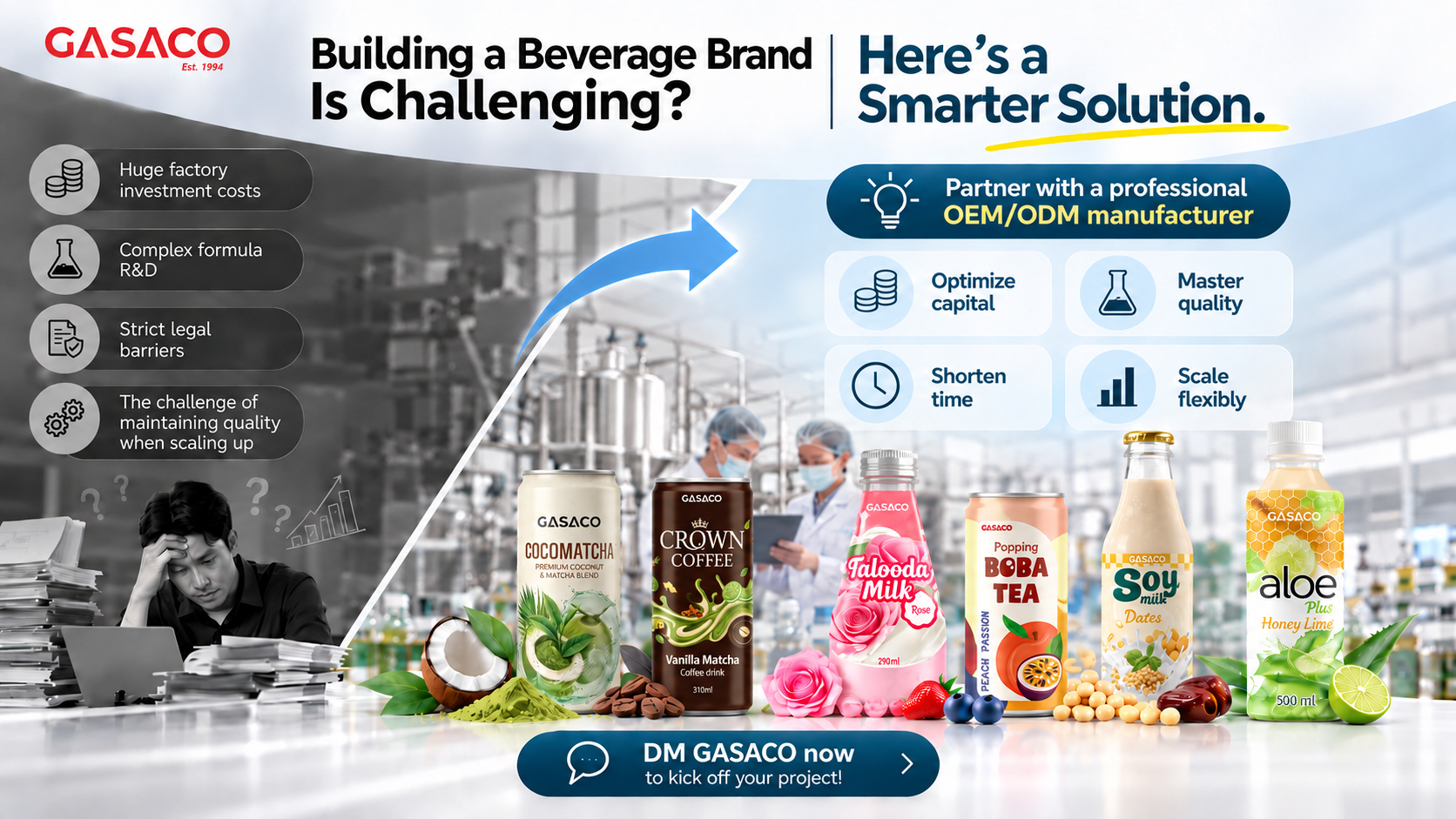
GASACO supports OEM/ODM beverage development, from formulation and sample testing to packaging selection and production planning.
Beverage packaging is no longer merely a protective layer for a product. In the modern beverage industry, bottle, can, closure, and shipping carton specifications influence how consumers purchase, carry, use, and repurchase products.
If businesses retain outdated packaging formats while consumer behavior changes, the consequences often emerge in inventory turnover, storage costs, SKU complexity, and distribution efficiency. Therefore, packaging selection should be considered a commercial and operational decision, not simply a design decision.
⚠️ Why Do Beverage Packaging Specifications Affect Consumer Behavior?
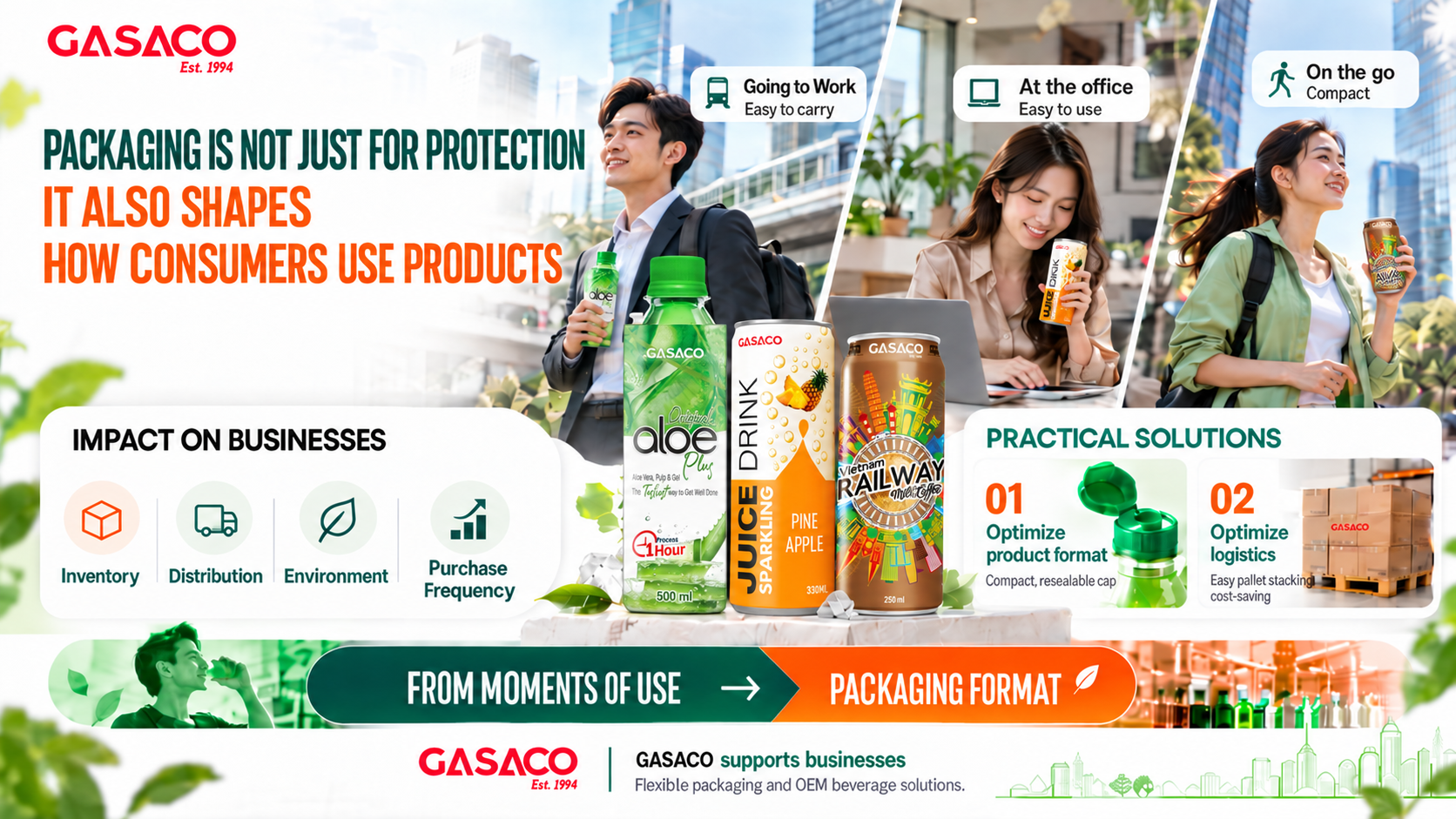
In urban areas, beverages are often consumed during short periods, such as commuting to work, taking a break, working at a desk, or traveling between retail locations. These situations increase demand for products that are easy to hold, convenient to carry, and suitable for individual consumption.
Compact container sizes are suitable for immediate consumption. Screw-cap bottles are suitable for situations where consumers may not finish the product in one sitting. Meanwhile, aluminum cans may be better suited to products that need to chill quickly, are intended for immediate consumption, and benefit from effective display in convenience stores.
Businesses should start with practical questions: Where do customers consume the product? How long does consumption typically take? Does the product need to be carried around? Will consumers finish it immediately after opening?
↔️ Should Businesses Choose PET Bottles, Glass Bottles, or Aluminum Cans?
No single packaging type is suitable for every beverage category. The selection should be based on product characteristics, price segment, sales channels, storage requirements, convenience, and logistics costs.
| Criteria | PET Bottles | Glass Bottles | Aluminum Cans |
| Portability | Lightweight, shatter-resistant, suitable for on-the-go consumption | Heavier, requiring greater control of breakage risks | Compact and lightweight, suitable for immediate consumption |
| Resealability | High when fitted with screw caps | Can be suitable depending on the closure design | Generally unsuitable for products intended for consumption over multiple occasions |
| Product positioning | Flexible, from mainstream to mid-range segments | Suitable for products requiring a premium perception | Suitable for modern, convenience-oriented beverages |
| Logistics impact | Requires optimization of bottle rigidity and carton specifications | Requires greater protection during transportation | Space-efficient, but denting risks must be minimized |
| Environmental considerations | Requires appropriate material selection and collection systems | Can be reused or recycled depending on the available operational systems | Recyclable, depending on collection infrastructure |
♻️ How Can Unsuitable Packaging Create Inventory and Distribution Risks?
A SKU with a container size or design that does not match market demand can face challenges beyond the retail point. The impact may extend to production planning, raw material management, warehousing, and delivery operations.
Inventory risks arise when businesses maintain SKUs with low inventory turnover. This increases the amount of working capital tied up in finished products, bottles or cans, labels, cartons, and related materials.
Logistics risks arise when bottle, multipack, or carton dimensions are not optimized for pallets, warehouse space, and transportation vehicles. Carton voids, stacking stability, and damage rates should be evaluated before mass production.
Commercial risks occur when a product does not match the intended consumption occasion. For example, large containers may be difficult to sell through convenience stores, while smaller sizes may not suit group consumption or household use.
❓ How Can Beverage Packaging Specifications Be Optimized for Urban Retail Channels?
Businesses should analyze each sales channel before finalizing packaging specifications. Convenience stores, mini-supermarkets, offices, takeaway outlets, and e-commerce channels have different requirements for container volume, resealability, transport durability, and product display.
❓ Which Packaging Specifications Suit On-the-Go Consumption?
Prioritize designs that are easy to hold, take up minimal space, reduce leakage risks, and suit single-use consumption or consumption over a short period. For beverages that may not be finished in one sitting, PET bottles with screw caps are an option that should be tested for the specific product and sales channel.
❓ How Can Businesses Reduce SKU Complexity?
Businesses should not increase the number of container sizes simply to create a sense of variety. Every new SKU adds requirements for bottle molds, packaging, labels, cartons, inventory, and demand forecasting. Businesses should prioritize specifications that serve multiple channels while maintaining clear differentiation in intended use.
⚙️ What Data Should Be Evaluated Before Finalizing Packaging for an OEM Beverage Manufacturing Project?
In an OEM beverage manufacturing project, finalizing packaging before assessing production feasibility can increase adjustment costs. The process should be guided by consumer data, product characteristics, and operational requirements.
| Stage | Data to Validate | Objective |
| Demand analysis | Sales channels, consumption occasions, price points, and competing container sizes | Identify packaging specifications with sales potential |
| Material selection | Beverage properties, storage requirements, durability, and resealability | Ensure compatibility between the beverage and its packaging |
| Sample testing | Sensory properties, seal integrity, stability, and filling performance | Reduce risks before mass production |
| Logistics design | Carton dimensions, load capacity, pallet configuration, and transportation | Control costs and product damage rates |
| Commercialization | Minimum order quantities, SKU planning, and inventory turnover | Align production with market demand |
✅ How Does GASACO Support Beverage and OEM Packaging Development?
GASACO supports businesses in developing products through OEM/ODM models, from formulation direction and sample testing to selecting PET bottles, glass bottles, or aluminum cans and organizing production at an appropriate scale.
To bring a beverage product to market successfully, businesses need to evaluate four factors simultaneously: consumption experience, product stability, logistics efficiency, and commercialization potential. Appropriate packaging helps preserve product quality and better align the product with actual consumer behavior.
GASACO – Comprehensive Beverage OEM/ODM Solutions
Core Capabilities: Specialized in bottled beverage manufacturing. Provides comprehensive packaging solutions, from glass bottles and PET bottles to aluminum cans.
Services: Private-label development and end-to-end OEM manufacturing. Flexible production capacity.
- Phone: 0987987512
- Address: 934 D1 Duong Street, Cat Lai Industrial Park, Cat Lai Ward, Ho Chi Minh City, Vietnam
- Website: gasaco.vn